When a commercial building needs work at height, the first question is rarely “what needs doing?” It is usually “how do we reach it?”
Rope access and cherry pickers are two of the most common answers. Both are safe and well established when used properly. Neither is right for every building, and the wrong choice can mean extra cost, extra disruption or a job that takes longer than it should.
Here is how we think about it.
What is rope access?
Rope access uses trained technicians working on ropes, with a main line and a back-up line, to reach areas of a building without fixed platforms. Our teams work to IRATA standards, and the equipment is checked and certified in line with LOLER and EN 795 requirements.
It suits work like façade cleaning, window cleaning, inspections, minor repairs and sealant work, especially where the work area is tall, narrow, awkward or hard to get equipment near.
Where it works well:
- Tall buildings or façades with limited ground space
- Glazing above entrances, canopies or landscaping
- Areas where heavy equipment cannot be positioned
- Short or targeted jobs where a large setup would be disproportionate
- Sites where keeping pedestrian areas open matters
What is a cherry picker?
A cherry picker is a type of mobile elevating work platform (MEWP) with a boom and a basket. Our operators work to IPAF standards.
It suits work where the operator needs a stable platform, a bit more working space, or the ability to carry heavier tools and materials.
Where it works well:
- Mid-height work with firm, level ground nearby
- Gutter cleaning, roofline work and cladding at moderate height
- Jobs needing more equipment or materials at the work area
- Longer tasks where a platform is more practical than working on ropes
So which one is better?
Neither, until you look at the building. The right method depends on a few things:
- Height and design of the building. A simple façade at moderate height is a different job from a glazed atrium or a stepped roofline.
- Ground conditions. A cherry picker needs space, firm ground and clear access. Car parks, soft ground, underground services and landscaping can all rule it out.
- Pedestrians and traffic. Busy entrances, public footpaths and delivery routes affect what can be set up, where and when.
- Duration and complexity. Short, targeted tasks and longer, equipment-heavy ones often point to different methods.
- Surroundings. Neighbouring buildings, trees, overhead lines and tight access can limit options quickly.
- Site operations. Tenants, visitors and working hours all shape the plan.
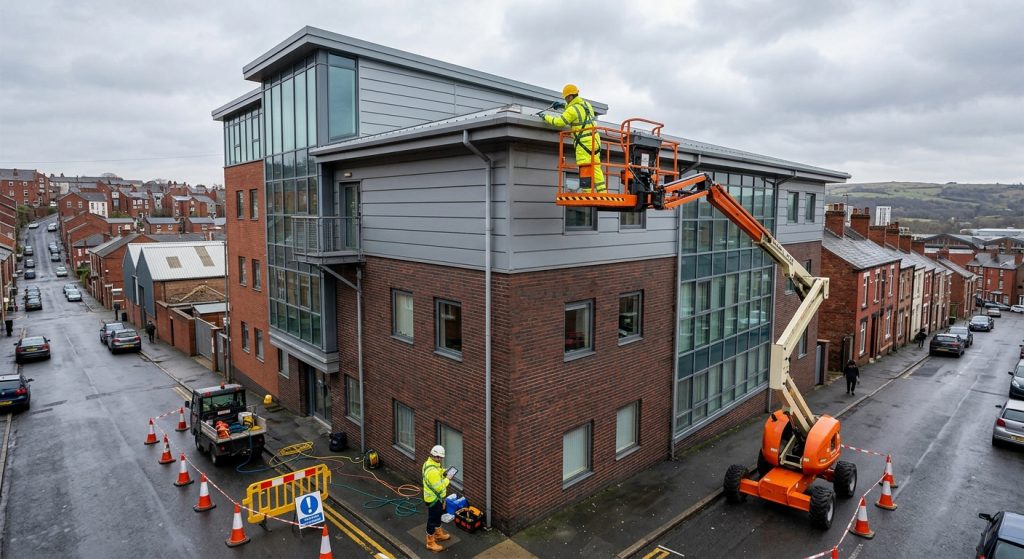
There are also cases where neither is the answer, or where a combination makes sense. A single job might use rope access for the glazing above an entrance and a cherry picker for the gutters along an open elevation.
Why a proper assessment matters
The most useful step is often the simplest: look at the building before deciding.
A site assessment looks at the building, the work required and how the site operates day to day. That makes it easier to recommend a method that is safe, practical and as little disruption as possible, rather than defaulting to whatever equipment happens to be available.
What this means for facilities teams
If you manage commercial property, a few practical questions help when you brief a contractor:
- What needs doing, and roughly where on the building?
- Are there entrances, walkways or car parks underneath the work area?
- Are there times when access should be avoided?
- Is this a one-off job or something that should become a planned programme?
Clear answers to these make the assessment faster and the quotation more accurate.
Talk to CRC Maintenance
CRC Maintenance is a Manchester-based commercial maintenance contractor offering rope access, cherry picker and other specialist access solutions across the North West, with support for suitable projects across the UK. If you are unsure which method suits your building, we can assess it and recommend a practical approach.