Commercial gutter cleaning frequency depends on tree cover, roof drainage design, debris load and maintenance history, not on the building label alone. The documented benchmarks range from one clear each autumn (Historic England) to a minimum of four clears a year for school roofs (Hertfordshire Grid for Learning). This article compares frequency for four building types: offices, warehouses, schools and retail parks.
How Often Should Commercial Gutters Be Cleaned?
Commercial gutters are cleared at least once a year, after autumn leaf fall, and more often where tree cover, debris load or blockage history raises risk.
Historic England’s maintenance checklist sets the benchmark: inspect and clear debris or blockages after heavy leaf fall, at least every autumn and preferably more often. The checklist covers traditional buildings and sets no sector-specific interval for commercial property. The Work at Height Regulations 2005 govern how gutter work is carried out, not how often.
Other documented benchmarks:
- Bradford Council: gutters and hoppers are cleared at least once a year, preferably after autumn leaf fall (historic rainwater goods).
- North East Lincolnshire Council: top-level gutters and hopper outlets are cleared at least twice a year, especially after winter leaf fall (cast iron gutters).
- Hertfordshire Grid for Learning: school roof gutters and drainage channels are cleared a minimum of four times a year.
A routine inspection checks outlets, joints and water flow. A cleaning visit removes leaves, silt, moss and debris. Inspection and cleaning produce separate records.
What Affects Commercial Gutter Cleaning Frequency?
Seven factors affect commercial gutter cleaning frequency: tree cover, roof area, gutter design, debris type, exposure, blockage history and access.
- Tree cover: Deciduous trees beside a roof shed leaves into gutters each autumn, which is why Historic England ties the clear to leaf fall.
- Roof area: A larger roof directs more rainwater and debris to each outlet.
- Gutter design: Box, parapet and valley gutters sit between roof slopes or behind parapets, so a blockage sends overflow towards the building structure.
- Debris type: Leaves, moss, silt and windblown litter block outlets at different rates, and school roofs also collect balls (Hertfordshire Grid for Learning).
- Exposure: London Borough of Waltham Forest’s school premises log sets gutter inspection at six-monthly intervals or more often, depending on location.
- Blockage history: Outlets with earlier overflow records carry a higher risk of repeat blockage.
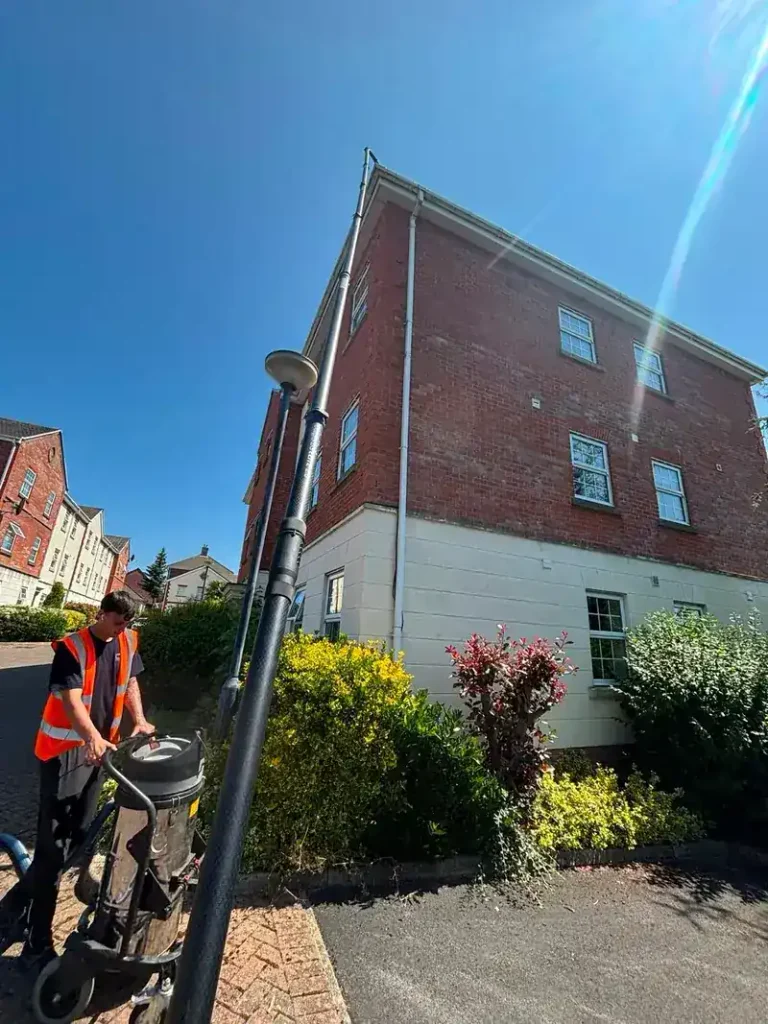
- Access: Ladders, mobile elevating work platforms (MEWPs), rope access and drone surveys each require a different set-up.
These factors replace a single fixed interval with a risk-based interval for each building.
When Should Commercial Gutters Be Cleaned During the Year?
Commercial gutters are cleaned after autumn leaf fall, checked again mid-year and inspected after severe weather.
- Autumn: Historic England sets the clear after heavy leaf fall.
- Winter leaf fall: North East Lincolnshire Council lists a second yearly clear, especially after winter leaf fall.
- Summer: Hinckley and Bosworth Borough Council’s building maintenance guide lists gutter and downpipe clearance for June to August.
- Severe weather: The same guide lists checks for overflowing drains after high winds and heavy rain, and Hertfordshire Grid for Learning lists roof checks for damage and ponding after a heavy storm.
How Often Should Office Gutters Be Cleaned?
Office gutters are cleaned on a risk-assessed interval, because the sources reviewed set no office-specific frequency.
Historic England’s autumn clear serves as a non-sector minimum benchmark. Office risk depends on roof type, tree cover, occupancy and maintenance windows. An office beside mature deciduous trees carries a higher debris load than an office with no overhanging canopy. Overflow in a multi-tenant office reaches occupied floors, so managing agents coordinate access with tenants.
How Often Should Warehouse Gutters Be Cleaned?
Warehouse gutters are cleaned on a risk-assessed interval, because roof span, gutter run length and site exposure vary between sites.
Large roof spans collect more rainwater per outlet. Long gutter runs and box gutters concentrate debris at few outlets. High-level access requires equipment such as a MEWP or rope access. Loading bays and yard movements limit access windows. No warehouse-specific interval appears in the sources reviewed.
How Often Should School Gutters Be Cleaned?
School gutters and drainage channels are cleared a minimum of four times a year, according to Hertfordshire Grid for Learning guidance for school roofs.
The guidance covers leaves, balls and silt. London Borough of Waltham Forest’s school premises log sets periodic inspections at six-monthly intervals, or more often in autumn or depending on location. The Department for Education’s Good estate management for schools guidance sets out an overall maintenance plan and a plan for day-to-day planned maintenance. Term dates and school holidays shape access planning for work at height.
How Often Should Retail Park Gutters Be Cleaned?
Retail park gutters are cleaned on a risk-assessed interval for each unit, canopy and shared drainage line, because roof layout and drainage responsibility differ between parks.
Multiple units place several roofs, canopies and outlets on one site. Shared drainage lines carry water from more than one roof. Customer footfall and trading hours shape access planning. Managing agents coordinate between landlords and tenants. No retail-specific interval appears in the sources reviewed.
How Does Roof Access Affect Gutter Maintenance Frequency?
Roof access determines the inspection and cleaning method, because the Work at Height Regulations 2005 apply to all work at height where a fall could cause injury.
The regulations set a hierarchy: avoid work at height, prevent falls with equipment, and minimise the distance and consequences of a fall. The Health and Safety Executive (HSE) publishes HSG33, Health and Safety in Roof Work, for roof work. Four access methods apply to gutter work:
- Ground-level inspection: Binoculars show visible roof and gutter damage from the ground (Hartlepool Borough Council guide).
- MEWP: A mobile elevating work platform reaches eaves gutters at height.
- Rope access: Rope technicians reach gutters on facades and roof edges.
- Drone roof inspection: A drone records roof and gutter condition without a person on the roof.

What Are the Signs That Commercial Gutters Need Cleaning?
Five signs show commercial gutters need clearing: overflow during rainfall, visible debris or vegetation, standing water, blocked outlets or downpipes, and water staining on walls or ceilings.
Inspection identifies the cause of each sign: blockage, failed joint or undersized outlet. Staining on walls or ceilings points to water ingress and calls for an inspection of the gutter above.
What Happens When Commercial Gutters Are Not Cleaned?
Blocked commercial gutters overflow, which sends water into walls, roof edges and internal spaces.
- Overflow: Water spills over the gutter edge onto facades, entrances and pavements.
- Water ingress: Box, parapet and valley gutters overflow towards the building rather than away from the building.
- Ponding: Standing water collects on flat roof sections when outlets block, and Hertfordshire Grid for Learning lists ponding checks after storms.
- Staining: Damp marks appear on walls and ceilings.
- Vegetation growth: Moss and seedlings establish in silt.
What Is the Difference Between Planned and Reactive Gutter Maintenance?
Planned gutter maintenance clears gutters on a set schedule before blockage, while reactive maintenance responds after overflow or water ingress.
Planned preventative maintenance sets intervals from building risk factors and blockage history. Reactive maintenance starts from a symptom such as overflow or staining. The Department for Education’s Good estate management for schools guidance describes planned maintenance as a documented plan.
How Should Businesses Plan a Commercial Gutter Maintenance Schedule?
A commercial gutter maintenance schedule records six inputs: risk factors, blockage history, seasonal checks, inspection records, cleaning records and review dates.
- Record roof type, gutter type, tree cover and access method.
- Review earlier blockages, overflow marks and storm damage.
- Set seasonal checks, starting with the clear after autumn leaf fall.
- Keep inspection records separate from cleaning records.
- Reassess the schedule after severe weather.
- Assign review dates for the schedule itself.
Commercial Gutter Cleaning Frequency: Quick Comparison
The table compares four building types by main frequency factors, evidence-backed interval and review triggers.
| Building type | Main frequency factors | Evidence-backed interval | Review sooner after |
| Offices | Roof type, tree cover, tenant access | Risk-assessed; at least every autumn as a non-sector benchmark (Historic England) | Overflow, staining, severe weather |
| Warehouses | Roof span, gutter run length, exposure, high-level access | Risk-assessed; no warehouse-specific interval found | Overflow, ponding, severe weather |
| Schools | Trees, balls, silt, term dates | Minimum four per year (Hertfordshire Grid for Learning); inspection six-monthly or more often in autumn (Waltham Forest) | Heavy storms, leaf fall |
| Retail parks | Multiple units, canopies, shared drainage, trading hours | Risk-assessed; no retail-specific interval found | Overflow, shared-line blockage, severe weather |
Intervals marked risk-assessed reflect the absence of a sector-specific interval in the sources reviewed. The Historic England benchmark covers traditional buildings and serves as a non-sector reference.
Frequently Asked Questions
How Often Should Commercial Gutters Be Inspected?
Commercial gutters are inspected at least every autumn, and school premises guidance sets inspection at six-monthly intervals or more often in autumn. The sources are Historic England and London Borough of Waltham Forest.
Is Gutter Inspection the Same as Gutter Cleaning?
No. Inspection checks gutter condition and water flow, while cleaning removes leaves, silt, moss and debris. Inspection records condition, and cleaning records removal.
Do Warehouses Need More Frequent Gutter Cleaning Than Offices?
No frequency ranking between warehouses and offices appears in the sources reviewed. Roof span, gutter run length, tree cover and blockage history set the interval for each building.
Are Commercial Gutters Cleaned Before or After Autumn Leaf Fall?
Commercial gutters are cleared after autumn leaf fall. Historic England sets the clear after heavy leaf fall, and a mid-year check removes spring and summer debris.
Conclusion: Choosing the Right Gutter Cleaning Frequency
Commercial gutter cleaning frequency follows building type, tree cover, debris exposure and maintenance history. Documented benchmarks run from one clear each autumn to a minimum of four clears a year for school roofs. Offices, warehouses and retail parks follow risk-assessed intervals, with inspection and cleaning recorded separately. A specialist survey records roof access, gutter type and blockage history as the basis for the schedule.
Where Can Commercial Property Managers Arrange Gutter Cleaning in Manchester and the North West?
CRC Maintenance is a Manchester-based commercial property maintenance contractor that provides commercial gutter cleaning services in Manchester and across the North West.
Related services include commercial roof cleaning and maintenance, high-level cleaning, rope access and drone roof surveys. IRATA-qualified personnel and IPAF-qualified operators support the access work, and the public liability insurance is £10 million. Customers include facilities management companies, managing agents, commercial landlords, estates teams and main contractors. Building types covered include offices, industrial units and warehouses, retail parks, schools and healthcare facilities.
Request a Quotation with the property location, required service and known access conditions.