A commercial roof maintenance checklist is a structured list of 9 inspection areas that facility managers use to check a commercial roof for damage, blockages, and wear. The checklist covers access, drainage, roof surface, flashings, rooftop equipment, and records. BS 6229:2018 sets the inspection frequency for flat roofs at a minimum of 2 inspections a year, one in autumn and one in spring.
Facility managers, property managers and commercial landlords apply the same checklist to offices, warehouses, retail parks, schools and healthcare facilities. The guide lists the 9 checks in order, with inspection frequency, safe access controls and the record format.
What Does Commercial Roof Maintenance Include?
Commercial roof maintenance includes 4 recurring tasks: scheduled inspections, cleaning, drainage clearance and record-keeping. Planned preventative maintenance fixes the inspection dates in advance. Reactive maintenance responds after a leak or failure appears.
Planned roof maintenance has 3 outcomes for a commercial building:
- Reduce repair costs by finding defects early.
- Extend asset lifespan by removing debris, moss, and standing water.
- Keep maintenance predictable for budgets and compliance records.
Preventative roof maintenance targets 2 defect types: roof leaks and water damage.
How Often Should a Commercial Roof Be Inspected?
A commercial flat roof is inspected at least twice a year, in autumn and in spring, according to BS 6229:2018. The standard covers flat roofs with continuously supported flexible waterproof coverings. The autumn inspection confirms the roof is clear of leaves, dirt, and debris, the outlets are unblocked, and the roof drains freely. The spring inspection finds weather damage.
BS 6229:2018 lists 4 triggers for an extra inspection:
- Extreme weather
- Vandalism
- Construction work on or next to the roof
- Installation of equipment on the roof
Roof age, roof condition, exposure, and nearby trees change the interval for a commercial roof inspection. Bauder, a flat roofing manufacturer, recommends 1 metre of clearance between overhanging tree limbs and the roof edge. Rooftop plant and access routes differ between offices, warehouses, retail parks, schools and healthcare facilities, which changes the checklist scope for each building.
How Is Safe Roof Access Arranged?
Safe roof access starts with a risk assessment, a method statement and a named person who authorises roof entry. The Work at Height Regulations 2005 require work at height to be planned, supervised and carried out by competent people. HSE statistics for 2025/26 record 31 falls from height among 126 worker deaths in Great Britain, around one quarter of the total.
Arrange 5 access controls before every roof visit:
- Complete a risk assessment for the roof and the access route.
- Write a method statement for the inspection.
- Identify fragile surfaces and rooflights.
- Restrict roof entry to authorised, competent people.
- Check access routes, railings and safety signage.
HSE guidance HSG33, Health and safety in roof work, covers fragile roof materials and rooflights. BS 6229:2018 states that trained and competent operators access the roof where permanent safe access is absent.
Rope access and a drone roof survey reduce the requirement for traditional access methods. A drone roof survey captures detailed images of roof areas for the inspection record. IRATA (Industrial Rope Access Trade Association) sets the training standard for rope access technicians. IPAF (International Powered Access Federation) sets the training standard for powered access equipment operators.
Which Signs Inside the Building Point to Roof Problems?
4 interior signs point to roof problems: ceiling stains, damp patches, drips after heavy rain, and staining near rooflights and walls. Top-floor ceilings and the areas below rooflights are the first inspection points. Moisture intrusion and water damage show inside the building before the cause is located on the roof.
Record 4 details for each interior sign:
- Note the location of the stain or damp patch.
- Measure the size of the affected area.
- Photograph the area with the date.
- Compare the sign with the previous inspection record.
Repeated staining in the same location indicates a roof leak. A roofing contractor locates and repairs roof leaks.
What Should Be Checked on the Roof Surface?
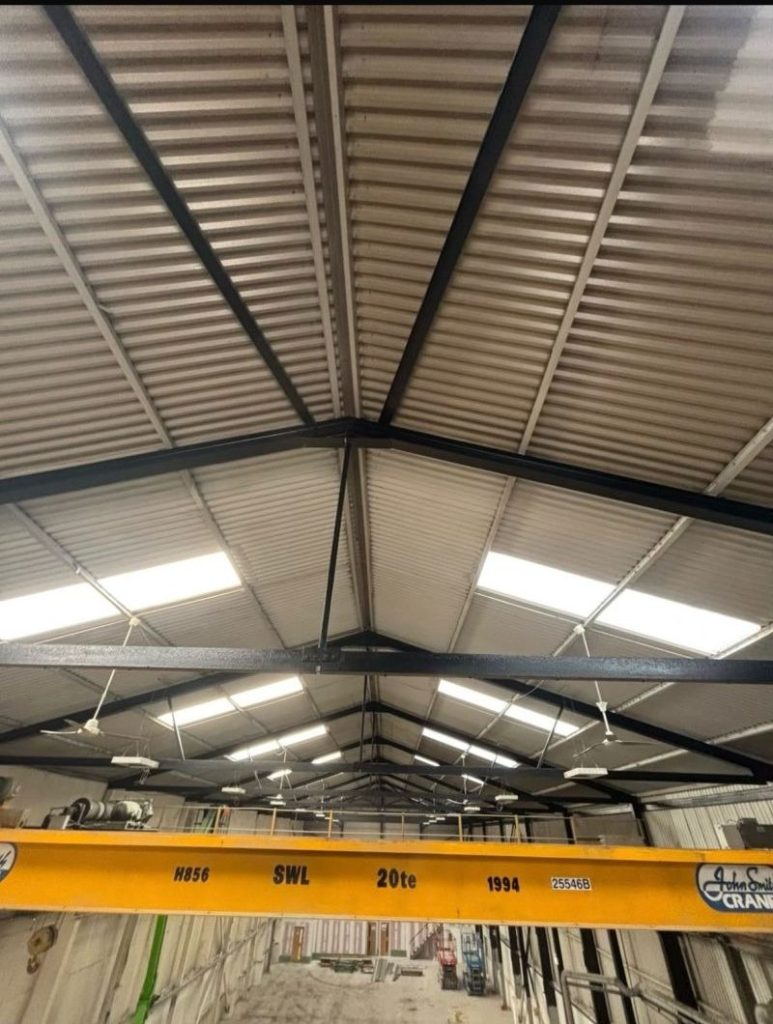
The roof surface check covers 6 conditions: visible damage, debris, moss, algae, staining, and standing water. Debris blocks outlets and holds moisture against the roof membrane. Bauder maintenance guidance states that sharp debris damages the membrane, so a visual inspection comes before debris removal. Moss and algae stain the surface and retain water. Standing water indicates blocked outlets or a surface that does not drain freely.
Flat roof maintenance records 3 attributes of the roof membrane: material, age, and condition. Flat roof inspection checks follow 4 steps:
- Look for cracks, splits, and lifted areas in the roof membrane.
- Note moss, algae, and staining by location.
- Mark standing water and photograph the area.
- Record the material, age, and condition of the roof membrane.
Commercial roof cleaning is a planned service scoped to the roof condition and access requirements. Drone inspections photograph areas that are difficult to reach. The inspection is visual. A roofing contractor decides on repairs.
How Are Gutters, Outlets and Drains Checked?
Gutters, outlets and drains are checked for blockages, debris and standing water at every roof inspection. BS 6229:2018 places the outlet check in the autumn inspection, after leaf fall. A commercial drainage system has 4 components: gutters, outlets, downpipes and drains. IKO maintenance guidance lists outlet function and blocked gratings as inspection points.
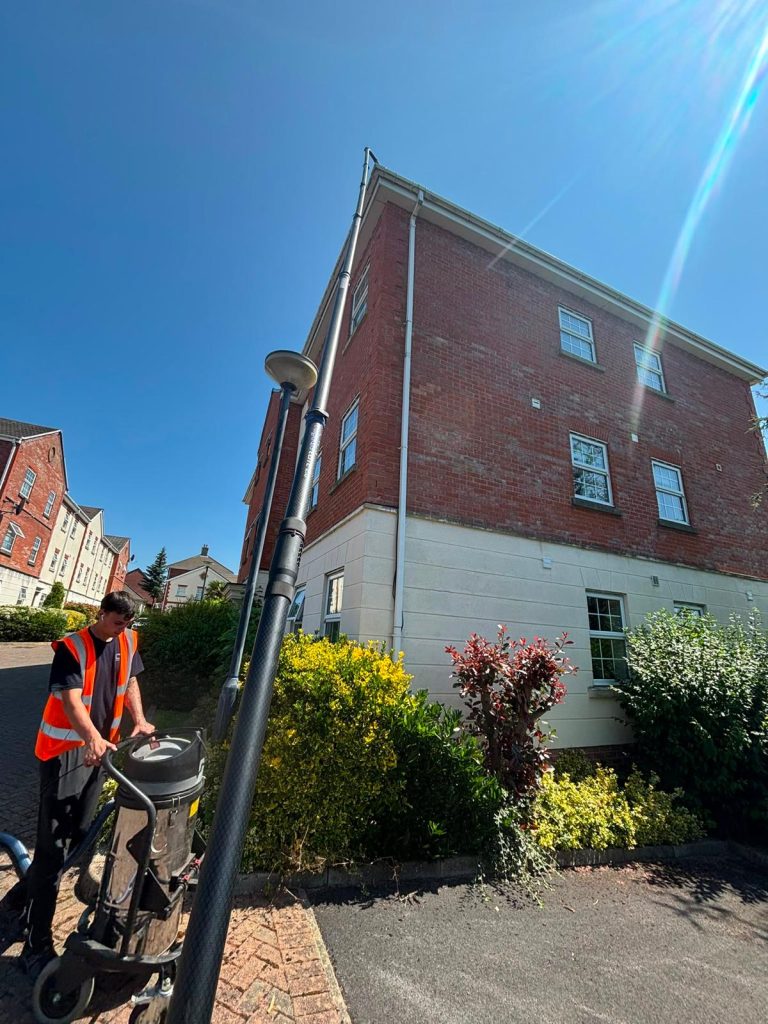
Blocked drainage shows as overflow staining and standing water. Facilities staff view outlets and downpipes from ground level. Gutters at height require trained operators and suitable access equipment. Commercial gutter cleaning removes debris and blockages, including in high-level and difficult-access gutters, and helps maintain effective drainage.
What Should Be Checked at Flashings, Upstands, Edges and Parapets?
Flashings, upstands, edges and parapets are the junction points where the roof surface meets walls and roof edges. Upstands are the raised roof edges at walls and rooflights. Terminations finish the roof covering at the edges. Gaps, lifting, cracks and staining at the junctions indicate water entry points.
Check 4 junction details at each inspection:
- Check flashings for gaps and lifting.
- Check upstands for cracks.
- Check terminations for staining and lifting.
- Check edges and parapets for visible damage.
A roofing contractor repairs flashings. The inspection records the position, the size, and a photograph of each defect. Cracking or movement at parapets and edges indicates structural deterioration.
What Should Be Checked Around Rooftop Equipment, Penetrations and Rooflights?
Rooftop equipment, penetrations and rooflights are checked for damage, loose fixings and condition of seals at every inspection. Rooftop plant includes air conditioning units and extract fans. Penetrations are the pipes, cables and ducts that pass through the roof covering. Pipe and equipment supports hold services above the roof surface.
BS 6229:2018 adds an extra inspection after installation of equipment on the roof. IKO guidance lists the waterproofing at rooflight kerbs as an inspection point. HSE guidance HSG33 covers rooflights as a fall hazard, so rooflights are marked and protected before roof access.
How Is a Roof Inspection Record Kept?
A roof inspection record logs 5 items: date, area checked, photographs, condition, and action taken. Bauder guidance states that the building owner keeps a record of all inspections and maintenance carried out on the roof. A roof condition report from a drone roof survey records visible defects, general roof condition, and areas requiring attention for the record.
3 roles use the roof inspection record:
- Facility managers own the record and update the issue log after each inspection.
- Property managers use the record to plan maintenance budgets.
- Commercial landlords use the record to show asset condition.
A roof maintenance plan links the record to the inspection schedule. The roof entry sits inside the maintenance checklist for the commercial building as 1 of several external assets. Minor issues are logged and reported to a roofing contractor. Planned preventative maintenance turns the record into a scheduled programme with fixed dates.
What Does a Commercial Roof Inspection Checklist Contain?
The commercial roof inspection checklist below has 9 rows, one row per check area. The columns list what to look for, who checks, how often, and a status field marked OK, Issue, or N/A. The table is free to copy or print for each inspection visit.
| # | Check area | What to look for | Who can check | How often | Status |
| 1 | Interior of the building | Ceiling stains, damp patches, drips after heavy rain, staining near rooflights and walls | In-house team | Every visit and after heavy rain | OK / Issue / N/A |
| 2 | Roof surface | Visible damage, debris, moss, algae, staining, standing water | In-house (safe view) or specialist/drone survey | Spring, autumn and after severe weather | OK / Issue / N/A |
| 3 | Gutters, outlets and drains | Blockages, debris, standing water, overflow staining | In-house from safe positions; specialist at height | Spring and autumn | OK / Issue / N/A |
| 4 | Flashings and upstands | Gaps, lifting, cracks, staining at junctions | Specialist or roofing contractor | Spring and autumn | OK / Issue / N/A |
| 5 | Edges and parapets | Visible damage or staining | Specialist or drone survey | Spring and autumn | OK / Issue / N/A |
| 6 | Rooftop equipment and penetrations | Condition of plant, pipes, cables, supports and seals | In-house or specialist | Spring, autumn and after any installation | OK / Issue / N/A |
| 7 | Rooflights and fragile surfaces | Visible damage, marking and protection | Trained people only | Every roof visit | OK / Issue / N/A |
| 8 | Access routes and safety | Access routes, railings, signage, risk assessment in place | Facility manager | Every roof visit | OK / Issue / N/A |
| 9 | Records | Date, areas checked, photographs, issues, actions | Facility manager | After every inspection | OK / Issue / N/A |
The completed table becomes the inspection record for the visit. Rows marked Issue go to a roofing contractor with the photograph and the location.
When Is a Specialist Contractor Used Instead of In-House Checks?
A specialist contractor carries out roof checks that involve working at height, hard-to-reach areas, or roof cleaning. In-house teams complete ground-level and safe visual checks.
In-house checks cover 3 tasks:
- Check ceilings for interior signs of roof problems.
- Inspect outlets and downpipes visible from ground level.
- Update the roof inspection record.
Specialist checks cover 3 tasks:
- Access high-level edges by rope access.
- Survey the roof surface by drone.
- Clean roofs and gutters in hard-to-access areas.
Roofing contractors repair roof coverings, flashings, and leaks. High-level cleaning and rope access cover elevated and hard-to-access areas that in-house teams cannot reach safely.
What Does CRC Maintenance Provide for Commercial Roofs?
CRC Maintenance provides drone roof surveys, commercial roof cleaning, commercial gutter cleaning and planned preventative maintenance for commercial buildings. The company operates from Manchester and serves the North West. A specialist subcontractor team of 22 experienced operatives supports the work, with IRATA-qualified personnel and IPAF-qualified operators. CRC Maintenance maintains £10 million public liability insurance.
The commercial roof maintenance checklist above covers 9 check areas, 2 inspections a year and 4 extra inspection triggers. Facility managers, property managers and commercial landlords request planned preventative maintenance through CRC Maintenance. A quotation request states the property location, the required service, the known access conditions and the timescale.
Commercial Roof Maintenance FAQs
Which areas does a commercial roof inspection cover?
A commercial roof inspection covers 9 areas: interior, roof surface, gutters and drains, flashings and upstands, edges and parapets, rooftop equipment, rooflights, access routes and records. The table above lists each area with the checks.
Which defects does a commercial roof inspection find?
A commercial roof inspection finds 6 defect types: blocked drainage, standing water, moss and algae growth, damaged flashings, water damage and weather damage. Each defect is logged with a photograph and a location.
Can facilities staff clear roof gutters themselves?
Facilities staff clear ground-level gutters. Gutters at height require a risk assessment, a method statement and competent operators under the Work at Height Regulations 2005. Commercial gutter cleaning covers gutters at height.
What does a roof inspection report contain?
A roof inspection report contains 4 items: visible defects, general roof condition, areas requiring attention, and maintenance considerations. A drone roof survey supplies detailed images for the report.